




How Compass Community Schools Cut Chronic Absenteeism and What Other Schools Can Learn
Chronic absenteeism continues to challenge schools nationwide, especially in the years following the COVID-19 pandemic. In a recent SchoolWorks webinar, Kathryn Koerner, SchoolWorks’ Director of School Design and Renewal, engaged with Kristi Baird, Founder and Executive Director of Compass Community Schools in Memphis, TN. Kristi shared how her network dramatically reduced chronic absenteeism without adding staff or increasing costs by focusing on equity, ownership, and strong school culture.
Below are key takeaways from the conversation, along with some of Kristi’s most resonant insights.
Context: About Compass Community Schools
Compass Community Schools is a network of six public charter schools serving approximately 1,500 students in Memphis, Tennessee:
- Five K–8 schools and one high school (a full K–12 continuum)
- 71% Hispanic, 26% African American student population
- 67% of students speak a home language other than English
- 77% of students reside in zip codes with the lowest median household incomes in the region
The Post-Pandemic Attendance Challenge
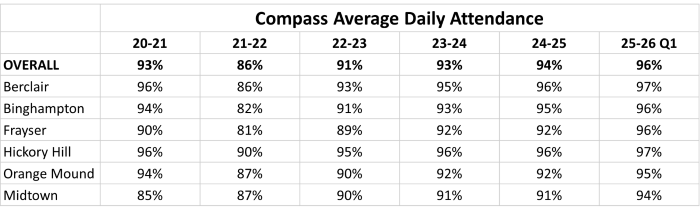
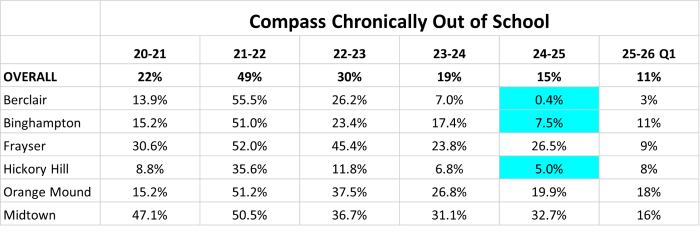
Like many school systems, Compass experienced a sharp rise in chronic absenteeism after returning to in-person learning following the COVID-19 pandemic. By the 2021–22 school year, nearly 49% of students across the network were chronically absent.
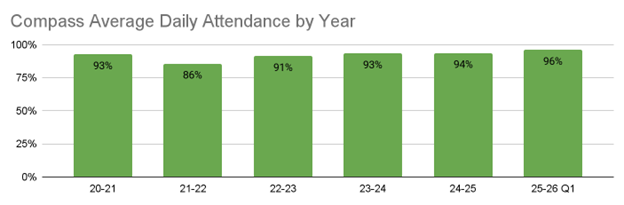
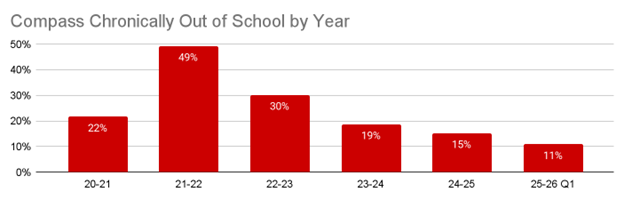
Several factors contributed to the challenge, including prolonged periods of remote learning, strict COVID contact-tracing protocols, and shifts in family routines and expectations during the pandemic. As Kristi reflected, “When we looked at the numbers on paper, we said, ‘Oh my goodness—we’ve got to do something about this.’”
A Mindset Shift: From Truancy to Support
A turning point came when Compass joined an Attendance Works cohort in the 2022–23 school year. The partnership helped leaders reframe attendance as a student support issue rather than a compliance problem.
“Most of our chronically absent students weren’t truant. There were reasons they were absent—and that changed how we approached the work.”
— Kristi Baird
Two key takeaways shaped their strategy:
- Attendance work must be grounded in equity, not consequences.
- Families must be treated as partners, not problems.
Importantly, Compass implemented these strategies without adding staff or increasing budgets, relying largely on free Attendance Works resources.
A Tiered Approach to Attendance
Compass applied a familiar MTSS-style framework to attendance:
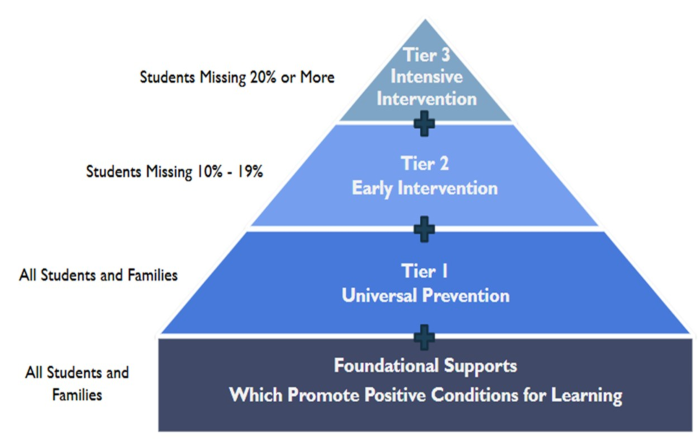
Tier 1: Universal Supports (All Students)
Tier 1 universal supports focused on strengthening schoolwide systems for all students, with a strong emphasis on belonging and connection. The school prioritized proactive, personal outreach by making daily live phone calls to families when students were absent, reinforcing the message that every student’s presence mattered. Attendance incentives were designed to be fun and celebratory, helping to build positive momentum rather than compliance-driven pressure. Consistent communication through newsletters, conferences, and school events kept families informed and engaged. As Kristi explained, “If your child wasn’t here by 8:15, you knew the school was going to call, and it was a real person on the other end.” Those calls made a tangible difference. Some parents felt more connected to the school, while others made sure their children arrived on time so they wouldn’t receive another call.
Tier 2: Targeted Supports (10–19% Absence)
Tier 2 targeted supports were designed for students approaching chronic absenteeism, focusing on early intervention and partnership with families. Before the school year began, school staff met with families to review prior-year attendance data together and develop a shared understanding of emerging attendance concerns. These conversations helped identify practical barriers, such as access to uniforms or supplies, or misconceptions about when students should stay home due to health concerns, that could interfere with regular attendance. Schools then used a Plan–Do–Study–Act cycle to test, refine, and adjust strategies over time, ensuring supports were responsive to students’ needs and grounded in continuous improvement.
Tier 3: Intensive Supports (20%+ Absence)
Tier 3 intensive supports were implemented for students experiencing significant attendance challenges, with a focus on individualized, wraparound care. Compass established attendance contracts and daily check-ins with trusted adults to provide consistency, accountability, and relationship-based support. Each student received an individualized plan tailored to their specific needs, complemented by small-group and one-on-one mental health supports. Using ESSER funds, Compass also brought in a licensed clinical social worker to support high school students struggling with post-pandemic anxiety. When the temporary funding ended, the impact of the work was strong enough that the school chose to sustain the position using its regular operating budget.
Ownership Is the Difference-Maker
While all six schools used the same framework, results varied. The biggest gains came from schools where one person truly owned the work. This person was often a counselor or office staff member, and not the principal.
Kristi: “They took the plan, worked the plan, revised it, and talked about it every single week—and that’s where we saw the biggest gains.”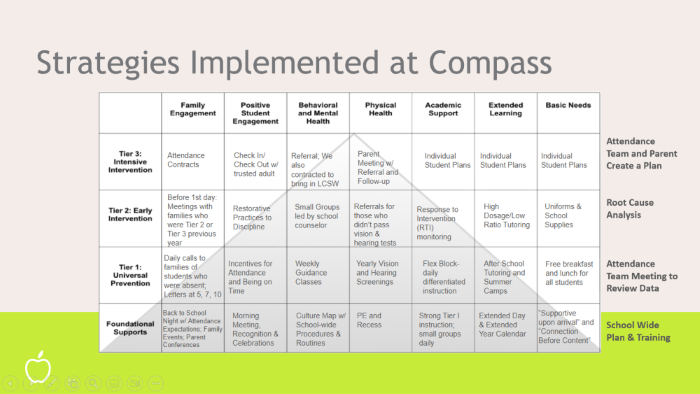
The Impact: Attendance and Academic Growth
The impact on both attendance and academic growth was significant. Five of the six schools reduced chronic absenteeism year over year, with Compass Berclair achieving one of the most dramatic turnarounds—reducing chronic absenteeism from 55 percent to just 4 percent. Importantly, the schools that saw the greatest improvements in attendance also experienced the strongest academic growth, reinforcing the connection between showing up and learning.
At Compass Berclair, these gains translated into exceptional academic outcomes. The school achieved the highest academic growth in Tennessee, doubled its AMO targets in math, science, and social studies, and came close to meeting AMO growth targets in ELA. As Kristi reflected, “We knew it intuitively, but the data confirmed it—when kids are in school, learning improves.”
Making Attendance Visible—and Celebratory
Attendance was made visible, and intentionally celebratory, across the school community. Data was shared openly and creatively, with daily attendance boards posted outside school offices and classroom-level attendance displayed on classroom doors. These visual cues kept attendance front and center for students and staff alike. The school also introduced fun, lighthearted incentives, such as hanging a pair of bedazzled “Smarty Pants” jeans as a schoolwide celebration, reinforcing attendance as something to be proud of rather than policed. As Kristi explained, “We wanted attendance to feel celebratory, not punitive—and that helped build buy-in with both students and adults.”
Final Takeaways for School Leaders
Kristi and Kathryn closed with a reminder that meaningful attendance improvement is not driven by quick fixes, but by disciplined, sustained follow-through. As Kristi put it, “When a need is identified, a plan is made with strategy and care, and it’s followed with fidelity, improvement follows.”
Resources
To watch the full webinar recording, visit the SchoolWorks YouTube channel here:
LINK: Practical Strategies for Reducing Chronic Absenteeism: Insights from Compass Community Schools
Additionally, we welcome you to download the presentation slides here.
For more information about SchoolWorks’ school improvement supports or school design and renewal supports, reach out hello@schoolworks.org anytime.